
Beyond Hasbara - From Explanation to Persuasion (Read this first)
Israel, the Valiant Defender

(This article was originally published in Prophecy: A Journal for Tomorrow)
Israel is suffering a series of battlefield losses.
While winning many stunning victories on military battlefields including Lebanon, Iran, and Yemen, Israel has failed miserably on the increasingly important battlefields fought on people’s phones and television screens. These narrative battlefields have become an integral part of the overall war waged by enemies who want to destroy her.
Israel’s enemies recognize that the military and narrative battlefield are fully integrated. Information is the most effective weapon Israel’s enemies have, and they are wielding it with the precision of an advanced military aircraft. They have used the weapons of information warfare with acute effectiveness; weaving powerful anti-Israel narratives and twisting reality with impunity while taking advantage of every mistake Israel makes.
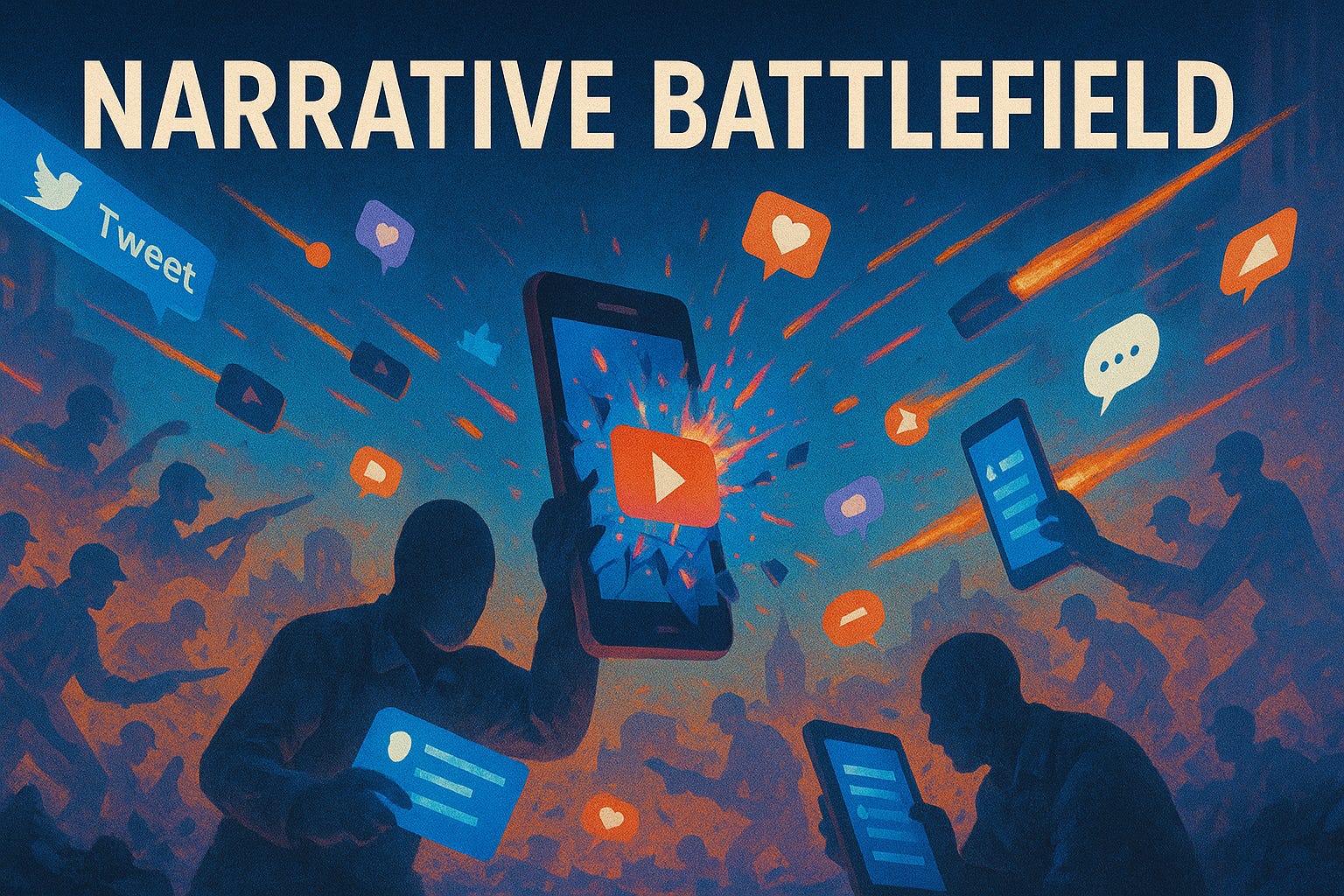
Israel is losing so badly on the narrative battlefield that Hamas has actually persuaded the world that they are the good guys. If Israel had been as ineffective with munitions as she has been with messaging, Hamas and Iran might control Tel Aviv right now.
As digital technologies become more central to our everyday lives, the influence of the narrative battle will continue to increase, and Israel will face serious security consequences if she does not fight more effectively. And, she needs to be smart because no other country’s survival requires it to manage its image so differently in different parts of the world. There is an inherent tension between the narrative Israel needs to craft in the Middle East and in the West: In the Middle East, where Israel needs to constantly deter brutal enemies who threaten her existence, she needs to be feared as a tough, invincible neighbor; In the West, on the other hand, Israel needs to be seen as a society that is valiantly defending itself against brutal, genocidal enemies, while adhering as much as possible to Western moral systems.
Instead of facing this challenge head-on with ingenuity and creative strategies, Israel’s narrative efforts have been handled with a combination of disregard, disinterest, indignation and incompetence.
This matters. We’ve crossed a threshold where it is now considered socially and politically acceptable, in private conversations and in public media, to overtly call for the destruction of Israel and her inhabitants. This mega-shift in public opinion is influencing governments once solidly allied with Israel, to take measures that are already beginning to compromise Israel’s security. Criticism of Israel coming from Western governments motivated Hamas to prolong the war and keep the hostages in confinement for a longer time. Criticism of Israel has led to arms embargoes, to boycotts and murders.
The gains made by Israel’s enemies on the narrative battlefield have reinvigorated the social acceptability of the ancient hatred of antisemitism, endangering Jews around the world. Whether we sought it or not, we, all the Jews of the world, are in this fight.
Israel has agency. Israel can decisively win narrative battles. Israel can return to being trusted, respected, emulated and seen as a valiant defender of her people.
Imagine Israel matching her military prowess with parallel capabilities on the narrative battlefield. Imagine a future when the world once again acknowledges that Israel’s military actions are designed to defend her people, her society and her homeland, not to commit aggression against her neighbors.
If we could bring about that future we could assure Israel’s ability to defend herself militarily without incurring the wrath and moral judgment of the world, avoiding weapons embargoes or sanctions from Western powers that have already started to emerge in the wake of that moral judgement. Moreover, Israel’s enemies would be less aggressive because they will know Israel’s ability to valiantly defend herself will not be curtailed through foreign influence. This could also lead to the normalization of relations with more Middle Eastern countries, further defusing the jihadist threat against Israel through alliances.
To make that future possible, Israel and the Jewish people need to launch a campaign to win back the territory Israel has lost on the narrative battlefields. This will require a concerted effort, starting now, with a goal of getting back on the winning side of the narrative battle within five to 10 years. Let’s call this effort “Beyond Hasbara.”
“Hasbara” means “explanation” in Hebrew and is the word used for “public relations” and for Israel’s communication of its positions internationally. The hasbara mindset has led Israel’s leaders and spokespeople to believe that their only task was to launch a barrage of fact-filled explanations.
Hasbara is an ineffective communication strategy, because explanations are rarely effective when trying to persuade other people. Think about regular life: How often can you just explain your point of view to someone who disagrees with you, and successfully change their mind? Rarely.
The goal of messaging is not to explain. It is to move the minds and motivate the actions of persuadable people. Humans are wired to think in stories, not statistics, and Israel’s enemies have done a masterful job creating a dramatic story in which they are sympathetic victims while Israel - and the Jews - are cruel aggressors.
Israel and the Jewish people need to stop explaining themselves and, instead, ensure that their actions and words cumulatively lead people around the world to believe a powerful, persuasive story about Israel.
Changing the narratives about Israel will not be easy, which makes it critical that Israel acts strategically and decisively - starting now.
So, what is the narrative we want people to believe about Israel? I believe it should be to recognize Israel as a Valiant Defender.
It was not long ago when the world recognized Israel as a valiant defender, facing harrowing odds yet still fighting successfully against enemies bent on her destruction. But now Israel is seen by millions not as a valiant defender of her people, her society, and her homeland but as a cruel aggressor.
To accomplish this, Israel needs to communicate - and live up to - an overarching story that she is a Valiant Defender of her people’s lives, resisting any actions or words that can paint her as a cruel aggressor. It is only through a combination of actions and words, reinforcing an overarching story, that Israel has a chance of moving public opinion.
The Valiant Defender Narrative states simply: “If our neighbors want to live in peace with us, we’re ready. But if they attack our children and our families, they can expect us to valiantly defend ourselves, in every situation.”
The idea of Israel as a Valiant Defender is the DNA of the Beyond Hasbara strategy. It is the glue that holds Israel’s story together.
Israel needs to not only talk like a Valiant Defender, she needs to act as a Valiant Defender, for one clear reason: People will integrate Israel’s words and actions in their minds as they form their beliefs.
In 2003 I wrote a book called Brand Harmony that describes how people form their beliefs of products, companies, organizations and countries by integrating everything they know about that entity into one combined story in their minds. For example, think of a company you are a loyal customer of. Your beliefs about that company were formed not just by what that company said to you, but as all the interactions you had with that company blended to create a compelling story in your mind. That’s Brand Harmony.
Brand Harmony’s lessons are very relevant for Israel’s current situation. To revive the narrative that Israel is a Valiant Defender, Israel needs to start ensuring that all of her actions and words blend, in a clear sense of Brand Harmony, to demonstrate, unequivocally, that she is a Valiant Defender and not a cruel aggressor.
Imagine if Israel’s leaders and spokespeople acted and talked in a unified way that supported the Valiant Defender Narrative. Israel’s narrative would be more widely accepted, and Israel would fare much better in the overall war she is fighting, improving her security and prosperity.
Yes, there are many obstacles to making that happen. Unified messaging is tough for Israel - a multi-faceted society with internal division, complicated politics and a people who have suffered significant trauma. Also, Israel’s government will need to avoid taking actions that erode Israel’s moral legitimacy and provide powerful ammunition that enemies can turn against her on the narrative battlefields. But, every bit of progress will help. Consider Israel’s improvements on the narrative battlefields less like an on/off switch and more like a dimmer switch; every slight improvement in Brand Harmony that communicates the Valiant Defender Narrative will make Israel’s prospects a bit brighter in the overall war she is fighting for her survival.
Israel can’t ignore how her actions are perceived, despite the heightened scrutiny and double standards that pertain solely to Israel. To account for the impact Israel’s actions have on the narrative battlefields, Israel needs to simultaneously consider both military and narrative battles when making policy decisions, even military ones. For example, there were valid military reasons to halt aid to Gaza, so that Hamas would stop stealing that aid and selling it on the black market to fund its terror machine. But by reacting with a military solution alone, Israel enabled its enemies to paint her as wicked and inhumane. Israel might be in a much better net position today if she had done the opposite and flooded Gaza with a surplus of humanitarian aid and services to ensure people were fed, reduce the price of black market goods and unseat Hamas’s place in the value chain.
Another example is enforcing that Israeli citizens who act as cruel aggressors against Palestinians be brought to justice with the same force as Palestinians who threaten Israelis. Allowing Jewish settlers to commit acts of terror against Palestinians with impunity instantly undercuts the Valiant Defender Narrative, for a simple reason: These are the acts of cruel aggressors. This can’t be allowed.
And, of course, the words Israel communicates are a crucial element of the Valiant Defender Narrative. Israel needs to communicate tight, easily-understood messages that support the overarching Valiant Defender narrative. Here are a few examples of how Israel could communicate that she is a Valiant Defender:
“For 80 years our enemies have been trying to destroy us - We fight because we’d all be dead if we didn’t. One thing our enemies can expect is that we will valiantly defend ourselves against their attacks.”
Or,
“Sure, we’d welcome a Palestinian state living peacefully next to us, but if they continue to threaten and attack us we will valiantly defend ourselves.”
Combined with complementary actions, words like this can create a compelling, persuasive Beyond Hasbara narrative.
Importantly, the Valiant Defender strategy works in both the Middle East and the Western fronts of the narrative war: For the Middle East, believing Israel is a valiant defender, willing to do whatever it takes to protect her people, is what has deterred Israel’s enemies in the past. For the West, the key to winning the hearts and minds of people in these societies is for Israel to be seen fighting only because she needs to protect her people from brutal enemies.
Israel’s current challenge - and opportunity - is to cast the story of the October 7th war as Israel’s valiant defense. To this point, Israel’s enemies have successfully hijacked the story of this war, defining the war in terms of Israeli aggression. But the two years of the war have not only shown Israel’s ability to defend herself, they have clearly illustrated how brutal and barbaric Israel’s enemies are, making this defense necessary. Now is a critical time to achieve stunning successes on the narrative battlefields.
Israel was once seen as a Valiant Defender. She had that asset, yet she squandered it. Can she get it back? Yes, but only if Israel and the Jews of the world commit to going Beyond Hasbara, starting now.
Very well done Steve. Thank you for sharing your insights.
Steve, excellent piece. The insight about hasbara literally meaning “explanation” is brilliant - it reveals how the problem is baked into the language itself.
Your analysis reminded me of the old political maxim: “If you’re explaining, you’re losing” - often attributed to Reagan-era strategists. Once you’re in defensive mode, justifying yourself, you’ve already ceded narrative control to your opponents. The explainer is reacting; the storyteller is leading.
Your Brand Harmony framework and the “Valiant Defender” narrative offer a genuine path forward. The dimmer switch analogy is especially wise - incremental alignment between actions and messaging, not overnight transformation.
The challenge you’ve identified is real: humans don’t process facts linearly; we integrate experiences into emotional stories. Israel’s enemies understood this. Time for Israel to catch up.