
What is in your hand?
It is time for the Jewish people to exercise our power to fight the narrative war more effectively

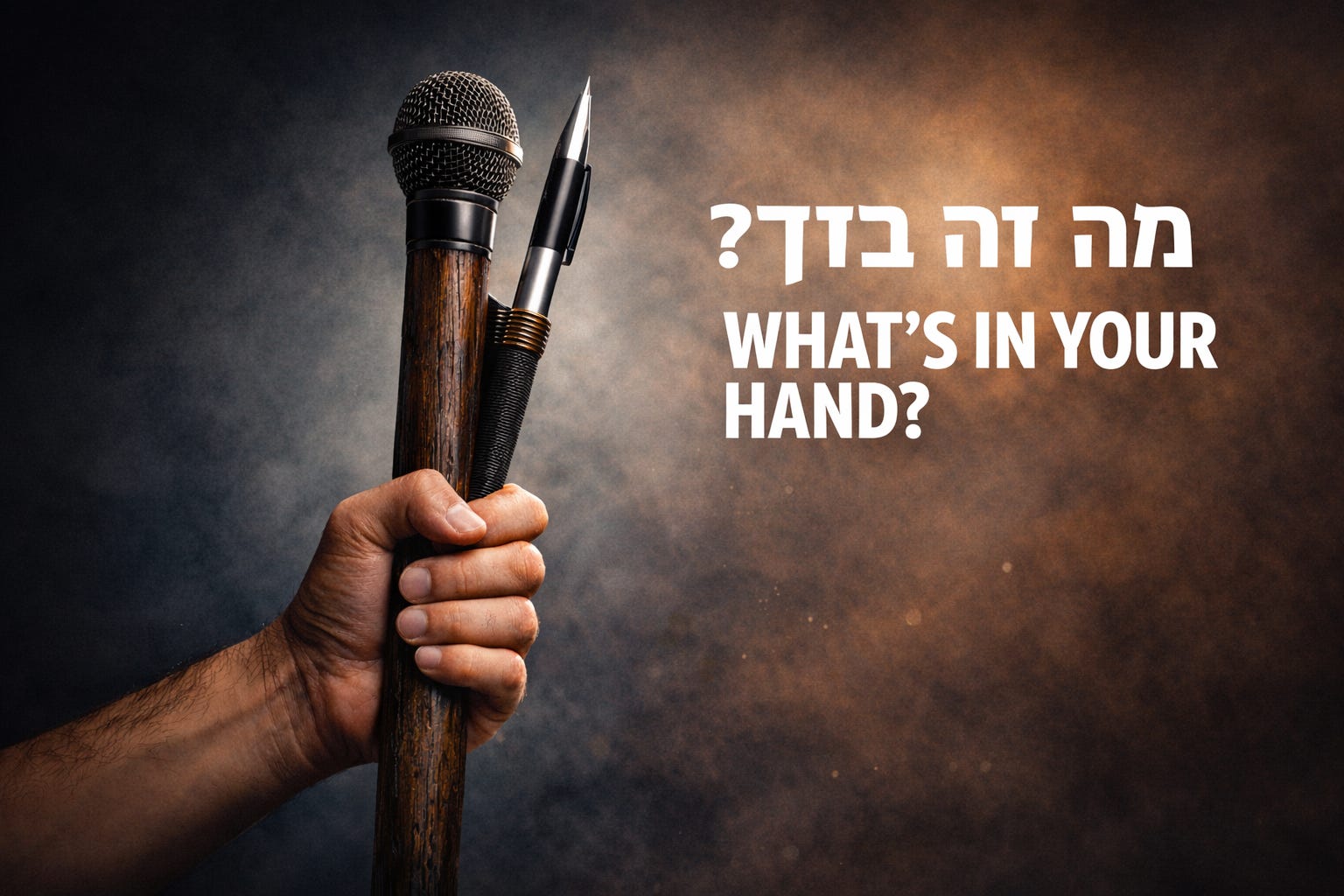
In Exodus 4, verse 2, God asks Moses, “What is that in your hand?” מה זה בידך Moses replies that he is holding a staff in his hand. God asks Moses to cast the staff to the ground, and the staff instantly turns into a snake. When Moses picks up the snake by its tail, once again it becomes his staff.
On the surface, the purpose of this story is to show God’s power. Moses had just expressed his concern to God that Pharaoh would not believe God was supporting him. This incident with the snake is God’s way of demonstrating that Moses should approach Pharaoh with the confidence that God has the power to back him up in his conflict with Pharaoh.
Yes, in this story God is demonstrating that he is all-powerful. But God is not just looking for a messenger. God is looking for a partner, and Moses’s actions are critical to the success of God’s plan to liberate the Israelites from Egypt.
Here’s the lesson: We Jews believe that human agency is critical to our success. We must participate in our lives if we want our lives to be good. (Credit to Rabbi Elliot Cosgrove for teaching about the role of human agency in Exodus 4:2 in his sermon on January 24th, 2026).
This lesson is valuable for the Jewish people at this critical moment in our history. Jew-hatred has reignited, with its two most virulent forms, antisemitism and antizionism, raging and spreading in ways that endanger Jews throughout the world. Yet we are not doing nearly enough about this situation.
Sure, we Jews are sounding alarms. Sure, we are complaining. Sure, we are posting charts, facts and maps on social media. But, to date, our efforts in the narrative war have been ineffective.
Our efforts on narrative battlefields are without direction. Our messages are fragmented and disconnected, and often absent. We are without cohesive leadership in the narrative war. We are acting helpless.
At the same time, our adversaries are communicating highly effective, unified messages that are persuading millions of people to believe that Israel - and, by extension, the Jewish people - are cruel aggressors not worthy of existence. We are allowing ourselves to get our asses kicked in the narrative war.
Imagine if every day there were 100 suicide bombings inside Israel, and 500 missiles from Hamas, Palestinian Islamic Jihad, Iran and Hezbollah raining down on Israel, yet Israel chose not to defend herself. Even worse, imagine if leadership in Israel pretended these deadly attacks weren’t happening, and turned a blind eye to them. What kind of damage would that cause? This is the military equivalent of how we are handling ourselves in the narrative war.
Of course, our losses in the narrative war aren’t yet resulting in the scale of death and damage that those suicide and missile attacks would cause. But note my intentional use of the word “yet” in the previous sentence. If we don’t start fighting back in the narrative war, the result could be the deaths of thousands - or millions - of Jews.
The narrative war is no longer a side show. It is an integral part of the overall war of annihilation our enemies want to wage against us, and it is the part of the war where they are having the most success. We can expect things to get worse, unless we start fighting back.
Let’s return to God’s question of Moses, and ask ourselves, “What is in our hands?”
Plenty. We may be a small community compared to our enemies, but we have ingenuity. We have creativity. We have technology. We have the track record of Jewish and Israeli successes. We have agency.
We must stop ignoring the narrative war. We need to stop fighting the narrative war as if we were a weak, helpless community, and start fighting this war with the strength we have.
We must start exercising our agency, the way God required Moses to use his human agency to lead the Israelites out of Egypt. We need to start acting. If we don’t act on our own behalf, our enemies will continue to pummel us in the narrative war, which will lead to the deaths of many Jews.
Deuteronomy 30 verses 12 - 14 gives us another lesson about the agency we have to affect our own lives:
(12) It is not in the heavens that you should say, “Who among us can go up to the heavens and get it for us and impart it to us, that we may do it?”
(13) Neither is it beyond the sea, that you should say, “Who among us can cross to the other side of the sea and get it for us and impart it to us, that we may do it?”
(14) No, the thing is very close to you, in your mouth and in your heart, to do it.
The answer to our problems is not in the heavens, it is right here, within us. We should not expect to be saved by what is known in theater as a “Deus ex machina,” which literally means “God from the machine,” and refers to a plot device where a seemingly intractable problem is suddenly solved, as if with help from a power above. Nope. The tide in the narrative war will not be turned by a deus ex machina. The way to fight the raging fires of antisemitism and antizionism is not to look to the heavens. It is to look in the mirror and motivate ourselves to act.
Act with the guidance of Deuteronomy 30, verse 14: “No, the thing is very close to you, in your mouth and in your hand, to do it.”
What about you? What is in your hand? What can you do, now, to help us turn the tide in the narrative war?
Here are a few thought-starter ideas:
Be Confident - Don’t Acquiesce
Don’t fall for it. Stay Jewish. Keep your resolve. Be proud.
Due to our enemies’ virtuosic powers with information weapons, many Jews have been sucked into their misinformation narratives. These Jews are, at best, underconfident about our virtues and, at worse, antizionist.
It is gaslighting at its most pronounced, and most successful, when Jews believe in the evil stories told about Jews and Israel. Yes, we’re not perfect. Yes, Israel has a dysfunctional government that sometimes does things that are hard to defend. But this does not indict the Jewish people or Israel as a nation. You and your children should not let yourselves be drawn into the vortex of anti-Jewish and antizionist stories.
This is step 1. Stay Jewish. Stay proud. Don’t fall for it.
Arm Yourself - Be Educated
One of the most important things you can do is educate yourself, and educate your children about the situation faced by Israel and Jews around the world. Facts won’t persuade detractors and haters, but the truth can strengthen Jewish unity, help us attract those who are neutral, and reinforce the beliefs of those predisposed to support us.
The reason many Jews actually believe the lies and libels and become either “conscientious objectors” or even antizionist is that they don’t know enough to recognize misinformation. A few months ago I was talking with a woman as we were both unlocking our bicycles at a bike rack in downtown Chicago. As we were talking I noticed her pull a keffiyah out her backpack, and I asked her to tell me about why she had it. She told me she was Jewish, but she thinks Israel is terrible and that the country shouldn’t be allowed to exist on “stolen land.” She then added more horrific accusations against Israel, each of which fits into the scientific category of “bullshit.” She spoke with certainty, as if there was no way she could be wrong. I tried the Socratic method, and asked her some questions, without being belligerent. In a very short time it became evident - to both of us - that she had no knowledge or understanding of the conflict, or of its history.
A Jew who is educated, knowledgable and aware will not believe libels such as “Israel is a colonial state,” “Israel is an apartheid state,” “Israel has committed genocide” and “it’s Israel’s fault that there is no Palestinian state.” On the contrary, under-informed Jews become ashamed of their Jewishness, are often afraid to display their Jewish identity, are always totally incapable of standing up for our rights, and often turn against their own people. For an astute and thorough analysis of this situation, which focuses on educating the next generation, please listen to this interview Haviv Rettig Gur conducts with Noam Weissman. Haviv and Noam offer clear ideas for educating and inspiring young Jews so they will be equipped to deal with the tough information environment that surrounds them.
Being educated does not, in any way, mean that you are supposed to believe in a mythical binary world where Israel and the Jews have done nothing wrong and all blame lies on our enemies. You should understand where Israel falls short. For example, effectively communicating that the main reason the Palestinians don’t have their own state is that they (or Arab powers on their behalf) have turned down many generous peace offers, requires you to also understand some of the obstacles Israel has put in the way of peace. If you want to defend against the libel that is Israel is an apartheid state, which it isn’t, you will be more effective if you understand and acknowledge incidents of Jewish terrorism in the West Bank. Be confident that if you know the truth, from all sides, you will still recognize that Israel is a valiant defender, trying to protect her people from genocidal aggressors bent on her destruction. Israel and the Jewish people are not perfect, but our situation is very difficult, and our cause is just.
Being knowledgeable will help you confidently and effectively resist antizionism in all its forms. It is now socially acceptable for people to say that Israel has no right to exist, and it is our responsibility as Jews to fight this at every point it comes up. Another story: A non-Jewish friend, who is a smart person of high integrity, told me that he is an antizionist and that he believes the IDF is evil. I pulled no punches in pushing back against what he said. Did I persuade him? Not 100%, but I have the sense he will think twice the next time he is tempted to spew dangerous ideas in public. And I refuse to stand idly by when someone says hateful, dangerous things to me about the Jewish people.
Be knowledgeable, and educate those close to you.
Take Aim at the Right Targets - Focus on Those Who Are Persuadable
People often say things like, “We can’t stop antisemitism,” or “If someone hates Jews, they will continue to hate Jews no matter what we do.”
Those people are right. We can’t change the minds of Jew haters, so let’s not try.
The good news: Most people aren’t Jew haters. Most people don’t have a strong opinion one way or another, and, in fact, with the exception of the younger generation, Jews and Israel retain widespread support among the populations of Western societies.
But what could happen to these neutral folks as time goes on? Recent history suggests that they are worth our focus. Consider that many people who weren’t thinking much about Israel and the Jews on October 6, 2023 were soon thereafter wearing keffiyahs, posting accusations of genocide against Israel on social media, and writing their political representatives to demand that the US stop funding Israel. Israel’s adversaries converted these previously disinterested yet vulnerable people through superior weaponry on narrative battlefields. Enough of these people were converted that government leaders and politicians in America and other countries have changed their policies towards Israel. Let’s stop losing those people to the other side. Although some of them were persuaded by highly biased college professors, most of them were persuaded by relatively superficial arguments on social media. In either case, we were not there to defend against our enemies’ misinformation and propaganda. Let’s start showing up for the fight.
Ignore the detractors and focus on those who are persuadable. However, there is one group of detractors whom you can boldly focus your attention on: Antizionist Jews. They deserve no coddling from the rest of us. They are not being responsible members of our community. Of course, they, like anyone else, are entitled to criticize the Israeli government, but when criticism of Israel, by Jews, morphs into antizionist beliefs and calls for Israel to cease to exist, those Jews have crossed a line that warrants reprimands from the rest of us.
In different articles on this Substack I have suggested other actions that we Jews need to take to turn the tide in the narrative war. These actions include clarifying our message, sparking a grass roots movement, and working to gain more unity within the Jewish community.
Of course, I don’t have all the answers, but then, I’m only one person (and I’m not Moses!). We need thousands of us to work together with unity, resolve and intention.
My immediate goal is to spark a conversation that encourages and motivates Jews to organize in order to act, so we can stop behaving like helpless idiots on the narrative battlefields. We need to start fighting more effectively, not only to defend ourselves, but to start winning these important information battles.
What other ideas do you have for combatting Jew hatred? How can you use what’s in your hands? Please leave your comment, or write to me directly. Let’s inspire each other.
Remember, “the thing is very close to you, in your mouth and in your hand, to do it.”
Agree - also would love your take on Bret Stephen's speech the other night at the 92stY