
When Stories Become Weapons
How ancient hatred travels through modern stories—and why we Jews are losing the narrative war

Humans think in stories, not statistics. Human emotions and beliefs are influenced by the stories we hear and believe. Stories and their related narratives guide our lives.
As Yuval Noah Harari teaches us in his book Nexus: A Brief History of Information Networks from the Stone Age to AI, what influences large groups of people to think alike and act alike are shared stories (“intersubjective realities”) that exist in the imaginations of many people. And, importantly, these shared beliefs don’t need to be true to be persuasive. In fact, it is easier to capture the minds of millions of people with stories that are not true than it is to spread the truth. The truth is often complex and difficult to communicate.
At this moment, evil, dangerous stories about the Jewish people are spreading at the speed of the Internet, inflaming the age-old scourge of Jew-hatred to levels not seen in years. These stories paint us as villains and aggressors, and their reach expands with each passing day.
It’s tempting to view “antizionism,” “antisemitism,” “Jew-hatred,” along with the libels currently in vogue to demonize Israel and the Jewish people, such as “genocide,” “settler colonialist,” and “apartheid,” simply as stand-alone concepts or phrases that can be defined, and then be debated rationally according to those definitions. But this isn’t how these terms exist. They do not stand alone. Each of them lives, spreads, and is sustained within powerful shared stories that fuel emotions, and, as we are now witnessing, also fuel escalating violence.
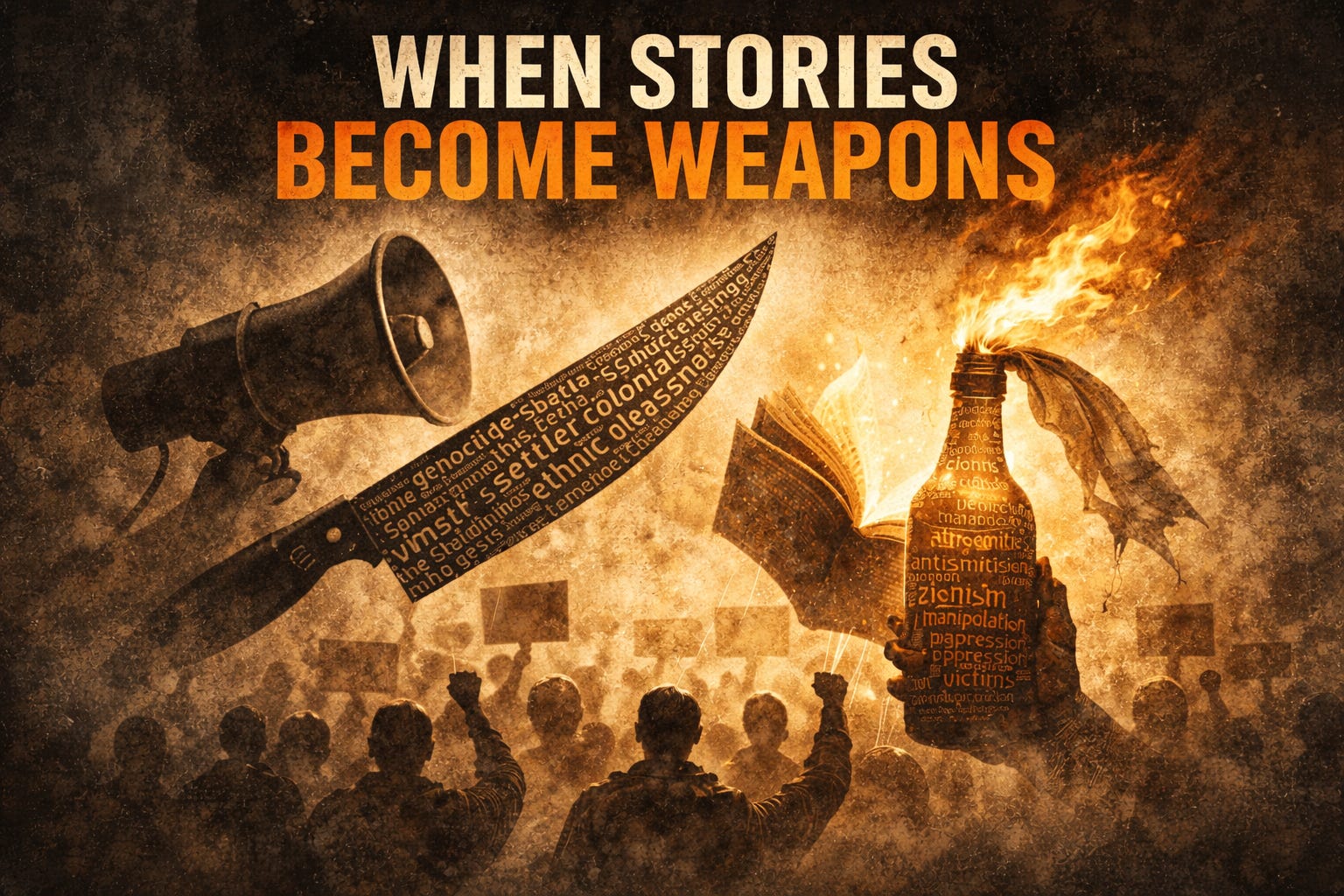
We Jews are caught in a narrative war that we are losing. And our losses are mounting every day. Our adversaries are fueling and managing the narrative war with skill and precision, as we act helpless and haphazard and get pummeled in this battle.
It is now acceptable in polite company to claim that Israel does not deserve to exist. Millions of people now considered it an accepted fact that the Jews of Israel all came from Europe and America, stole land from Palestinians, and have worked to subjugate them ever since. It is now considered logical to blame Benjamin Netanyahu for violent acts against Jews in the diaspora.
Yes, these claims are ridiculous. But their ridiculousness does not diminish their power. They travel within powerful, compelling stories that not only reinforce the pre-held beliefs of long-time Jew-haters, but also persuade the previously non-committed. People who just two years ago were posting pictures of their cats and children on social media are now posting pictures of themselves in keffiyehs as they chant “globalize the intifada.” Have they learned a lot about Israel and the Palestinians during that time? No. They have been captivated by powerful stories.
And the collective power of these stories is massive. Governments are adapting their policies as they see their constituents riding the wave of anti-Jewish sentiment. Terrorists are emboldened. (The zeitgeist turning so decisively against Israel certainly encouraged the Bondi Beach terrorists, and other violent actors, to act as boldly as they did.)
Which leaves us with our most important question: What are we Jews going to do about it?
Our adversaries have mastered narrative warfare. They coordinate their stories with precision while we communicate fragmented, disconnected messages. They understand that stories overpower statistics, that emotions beat facts, that shared myths move masses.
We’re still trying to win with better “hasbara”—more facts, more explanations. Our adversaries are winning with better stories.
But here’s what gives me hope: The Jewish people have survived and thrived by doing one thing better than our enemies—coordination. In 1948, 1967, 1973, fragmented Arab armies lost to coordinated Israeli forces. In keeping our culture alive through centuries of exile, building a modern nation, absorbing millions of immigrants, creating a startup economy—we have succeeded when we’ve managed to collaborate and coordinate despite our small numbers and limited resources
We know how to do this. We’ve proven it on military battlefields, in economic development, in nation-building. The question is whether we can apply those same coordination principles to narrative warfare—before it’s too late.
In future articles I’ll explore what that coordination looks like in practice. I’ll suggest ways to turn the Jewish people’s proven ability to coordinate under pressure into a narrative strategy that can counter the stories that are strangling us. Not with better explanations, but with a story of our own—one that’s true, powerful, and difficult to ignore.
The need to act is urgent. The path forward exists. We just need to recognize that we’re in a narrative war and start fighting it like we fight every other existential threat—together, coordinated, and with the determination that has kept us alive for thousands of years.